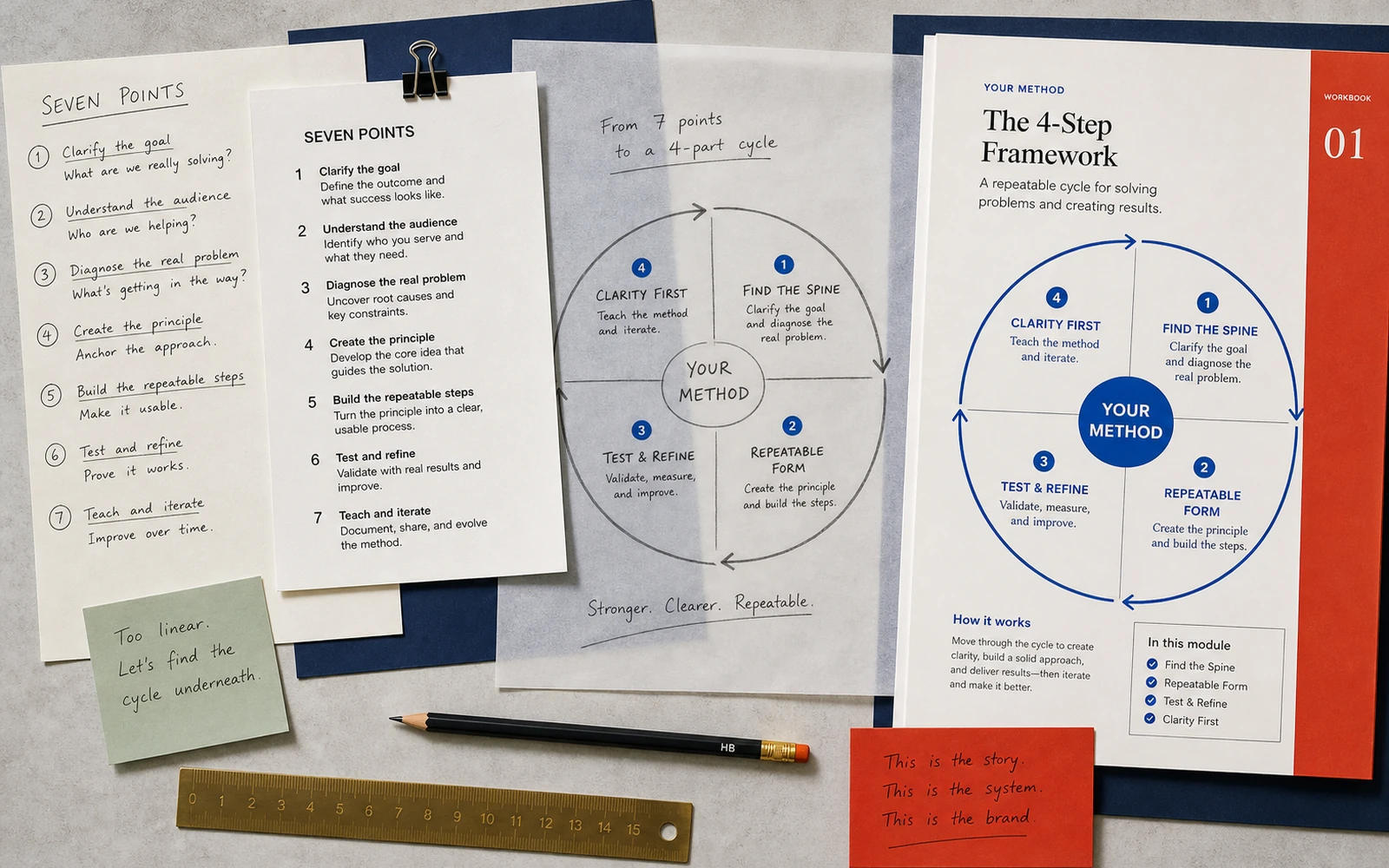
An expert method often lives as a list of points: convincing in the voice, impossible to reconstruct a week later. This is not about the “diagram page” in a workbook, and not about type hierarchy. It is about pulling geometry out of the method, fixing it as an asset, and not killing the clarity with decoration.
A branded diagram is not a logo on a chart. It is a set of rules for nodes, links and labels by which the method is recognised as yours.
Why a method needs a form
A list of seven points is easy to mix up with someone else’s. A cycle of four moves in the same geometry comes back on its own. Form also disciplines the author: while the method lives only in speech, the steps can change every time. Fixed geometry forces you to name the spine — and then the method can be handed on.
Find the structure already in the content
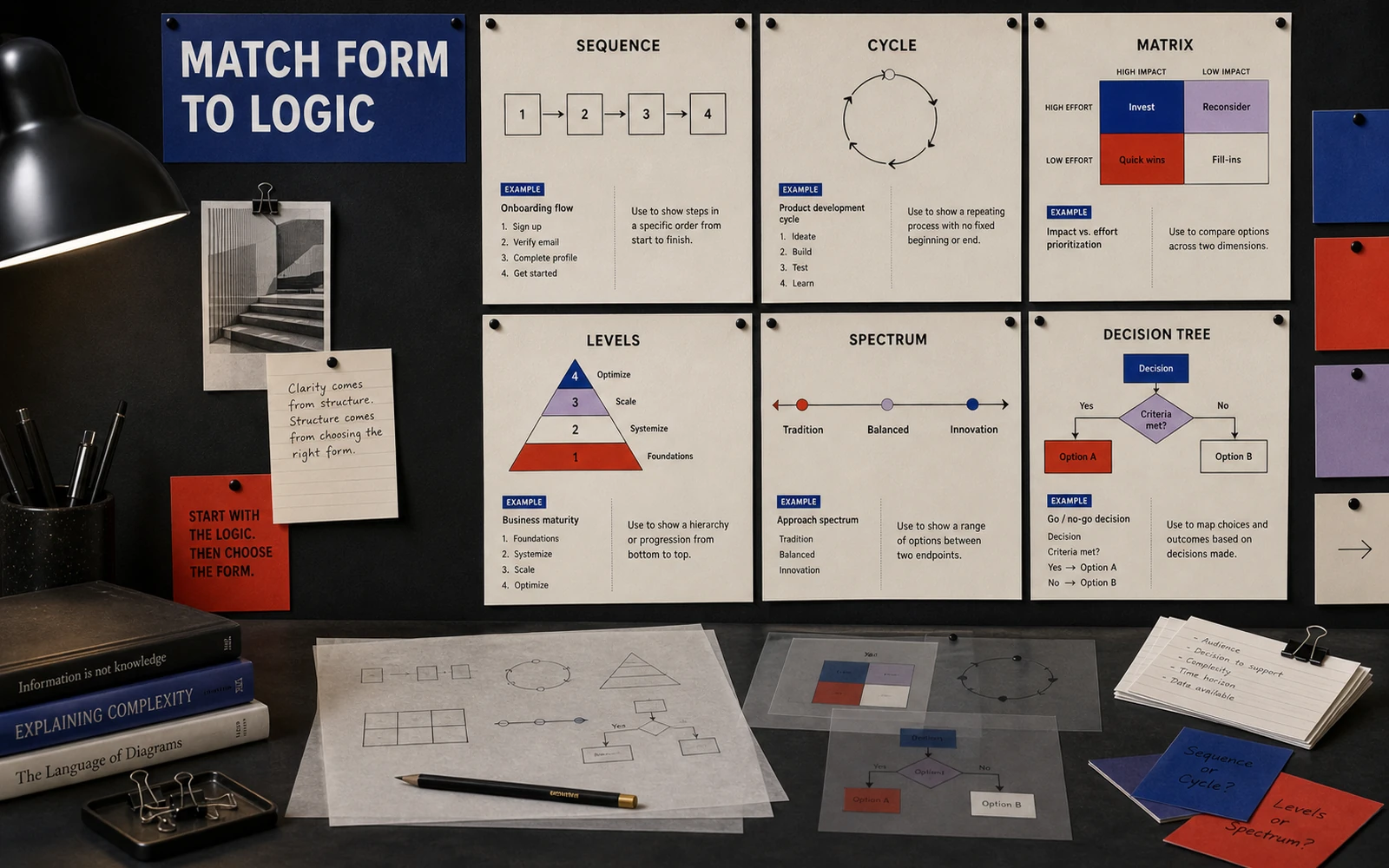
Not every idea wants to be a diagram. First look at what kind of logic is already in the material. Sequence: steps that follow one another. Cycle: a return to the start at another level. Matrix: two axes of choice. Levels: depth or maturity. Spectrum: not rungs, but tension between poles. Decision tree: if-then branching.
These types rarely sit on the surface. Experts often tell stories, and the structure hides in the repeats. Write the method down without examples. See what is a required order and what is illustration. If there is no order, a diagram will not save it. The thought has to be assembled first.
Sometimes one module holds several structures. Do not crush them into one “master map of everything.” Two honest forms beat one decorative picture that pretends everything is joined by rings.
Choose a diagram that matches the logic
The usual mistake is to stretch a funnel over anything that “goes downwards,” a circle over anything that repeats, a pyramid over anything with a “base.” Form should follow the relations, not the fashion in infographics.
If the steps still make sense in another order, it is not a sequence, even if you numbered them. If a person can be in two states at once, they are not hard levels. If the choice is not two-axis, a matrix only pretends to be strategic. An honest diagram is sometimes quieter. It is also easier to remember, because the brain is not arguing with the picture.
Choose one primary form per method and protect it. Variations are for examples and emphasis, not for a new geometry every lesson. Otherwise the brand of the diagrams appears and dissolves at once.
Build a repeatable language of diagrams
A language appears when node, arrow, accent and label live by the same rules, and an example is not dressed up as a step of the method. Fix the small things: length of the label, where the number sits, the mark for “you are here.” Without that, every new diagram is a separate illustration.
If the diagram only reads in a large mockup, it is not ready for a lesson. That is a test of whether the form works, not of how the page is set.
The brand of a diagram begins where clarity matters more than recognition. Recognition then arrives as a consequence.
Adapt one framework across formats
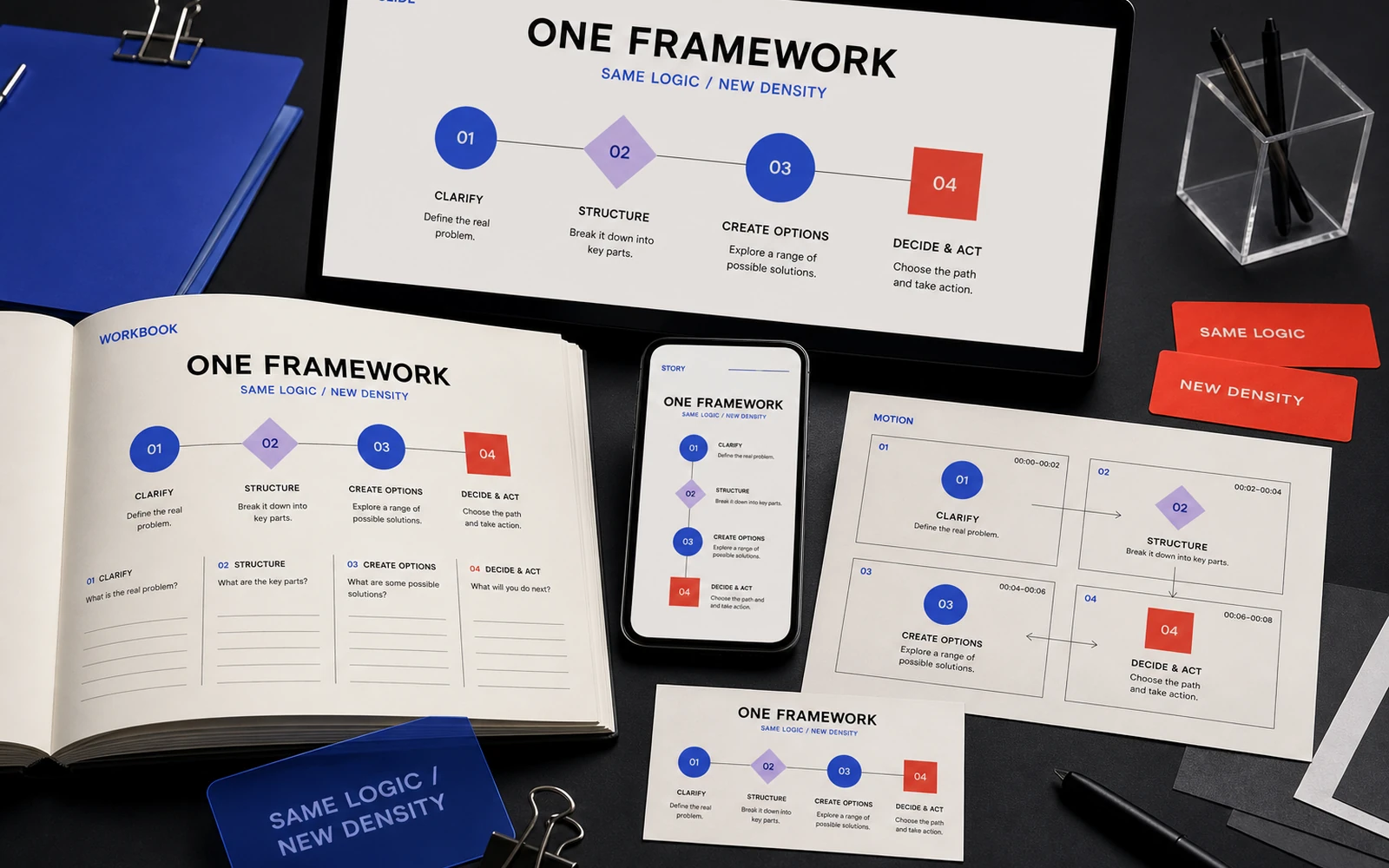
What changes is the density of the showing, not the logic of the method. The full frame belongs in the material where there is time. The current step belongs where attention is short. A single move belongs in a story frame. The gathering of the order belongs in motion, without a new metaphor “for energy.”
If a short frame forces you to draw a different model, the inner diagram is overbuilt. The name of the method stays the same everywhere. Otherwise the asset you just made dissolves at once.
Do not let branding kill the clarity
A diagram can be recognisable and unusable. Decoration on the nodes, a brand colour without contrast, a decorative perspective, type along an arc that cannot be read. Then the brand wins and the learning loses. The learner remembers “a nice picture” and cannot use the method.
Clarity is the first test. Readable on a lesson screen and on a phone. Honest: the form does not promise links the content does not have. Useful: you can ask someone to fill the diagram with their own case. If that cannot be done, it is a mood illustration, not a framework.
Branded diagrams earn their keep when expertise gets a form worth repeating. Then the method is easier to teach, easier to recognise, and easier to return to in a month. The knowledge stops being a set of points. It becomes intellectual property of the product — visible, transferable, and held together.