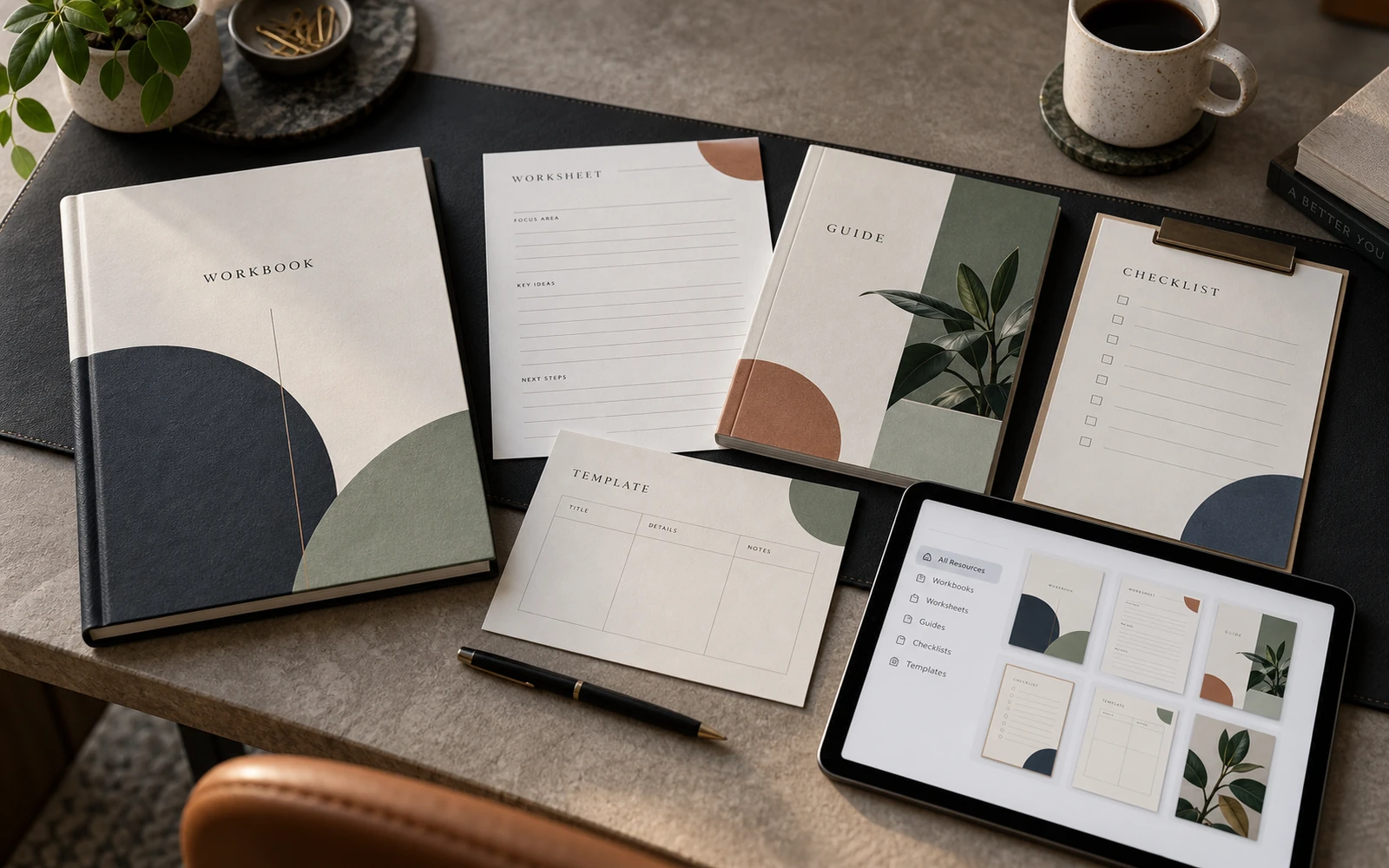
Many courses, by habit, put every material into one large workbook. It is awkward in a live lesson, hard to update one module, and the format does not match what the learner is actually doing. Sometimes a person needs a single page of action. Sometimes a reference they can return to. Sometimes a field they can print, without hunting through eighty pages. Choose the carrier for the job, not because “we have a PDF.”
Different formats do not break a product if they belong to one family. What breaks it is stitching everything into a volume nobody uses as intended — or letting every file look like a separate project.
Start from the learner’s action
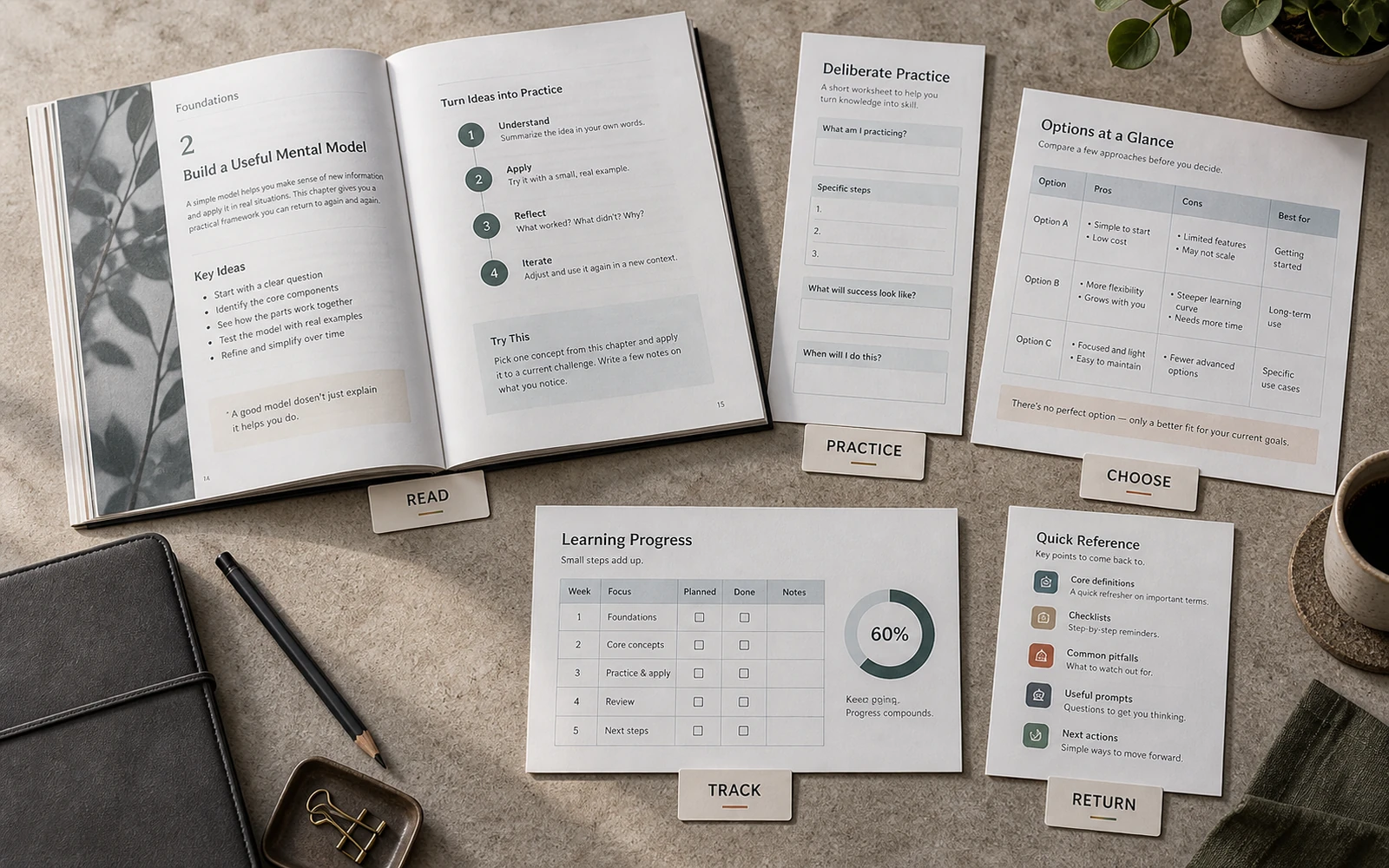
Name the job first, not the file. Reading: following a thought through hierarchy, example, pause. Practice: writing, calculating, assembling their own case. Choice: comparing options and locking a decision. Tracking: seeing progress across weeks. Return: coming back to a model without watching the lesson again.
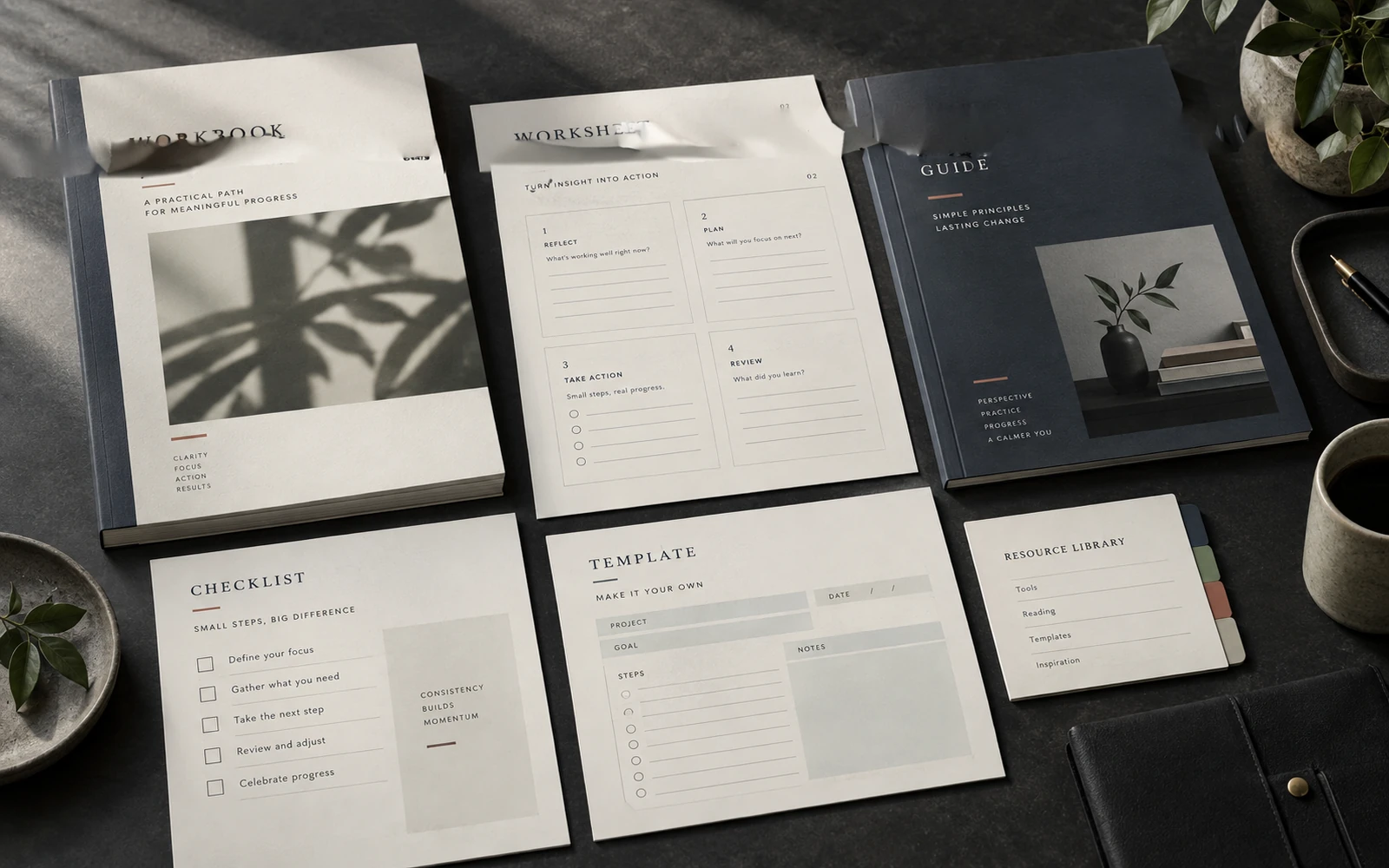
Those jobs rarely fit one carrier equally well. A long workbook holds reading and a through-line. A separate worksheet lives better in a session where there is no time to scroll a volume. A checklist and a template cut the load when someone needs to act, not relearn the structure. A guide holds reference you would hate to bury between exercises.
If you start from “we need a 100-page workbook,” you are designing an artefact. If you start from the jobs in the module, you are designing use.
When the workbook should be the core
A workbook earns its place when the programme has a through-line: modules accumulate, and people need one body of the course to come back to. That is a spine, not a storeroom. One-off handouts, platform updates and promotional launch checklists thicken the volume and hide the page they actually need.
The test is use, not appearance: can someone get through a week of the programme with this file as the main companion? If they constantly need “other files beside it,” the core was built from the habit of having a PDF, not from the job.
When a separate worksheet works better
A worksheet is for an action that is narrow and repeated. A live session. One model filled in every week. An exercise that needs to sit on the table, not be hunted for in the middle of a volume. A short frame after the lesson that can go to a coach.
A separate sheet cuts friction: only the task now is visible. That is not “less serious.” It is the more precise carrier for a session. A worksheet weakens when it replaces the whole course: the spine disappears and a stack of sheets remains. And when the sheet cannot be found from the lesson title — then the action falls off the path, even if the form itself is well made.
Guides, checklists and templates
Reference materials take cognitive load off. A guide: how to use the method after the course, how to set up a process, how to read a diagram. A checklist: not forgetting the steps in a real task. A template: not building a table or a brief from nothing.
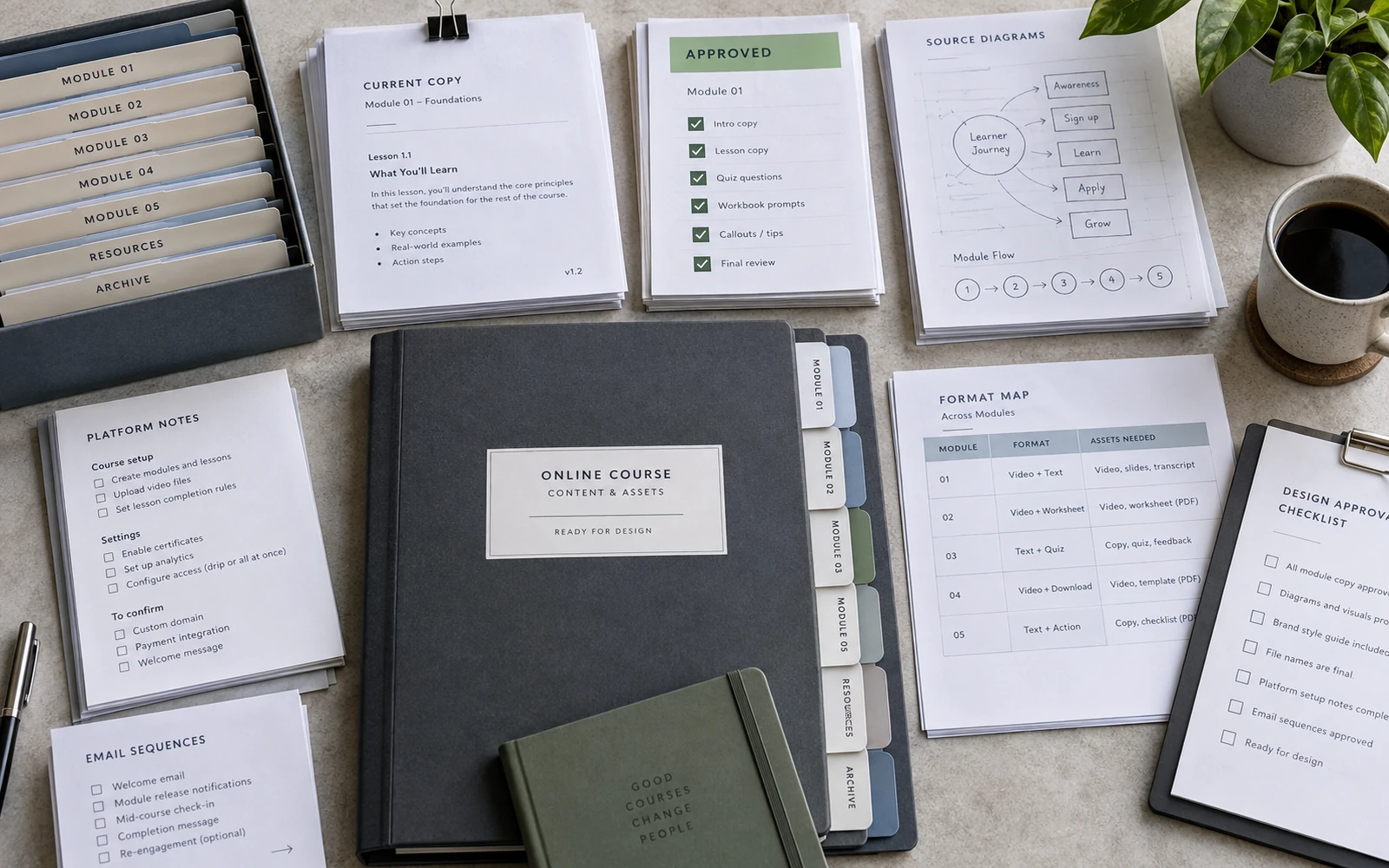
Their job is reuse without relearning. So they have to be findable: a clear name, a place in the resource library, a link to the module where they were explained. If a template is buried on page 67 of the workbook, it barely exists.
Do not make a guide where an exercise is needed, and do not make a checklist where the person has not yet understood the model. Format will not compensate for unfinished content. It only fits around it.
One volume for every job looks like a system. More often it is simply inconvenient.
Digital, print and mobile limits
The carrier constrains the job. A printed worksheet gives room to write and does not depend on a platform tab. A long on-screen PDF lives badly on a phone: fields shrink, scrolling tires, tables break. Interactive fields are convenient at a desk and irritating if the course is watched from the sofa.
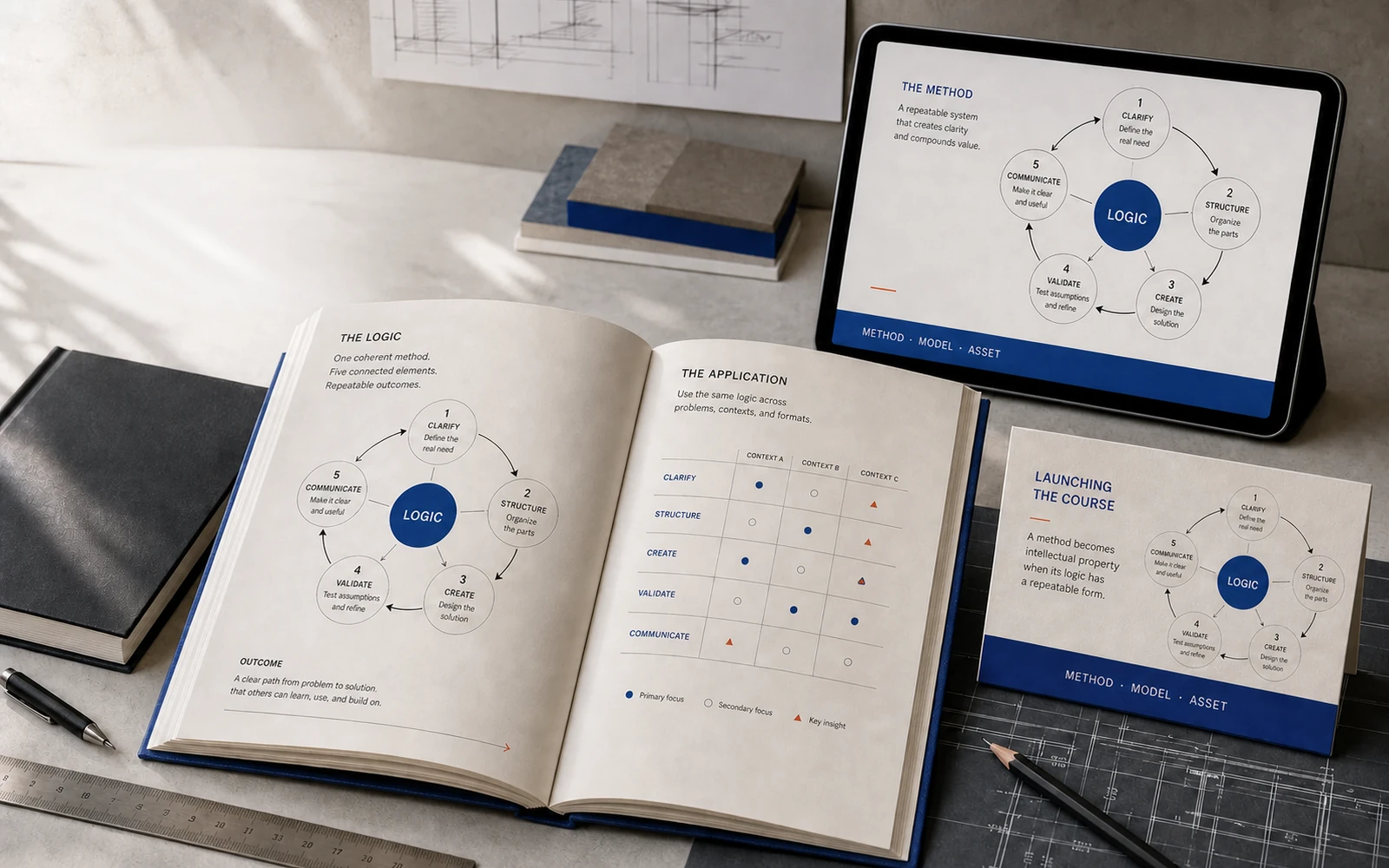
File weight, navigation, the ability to print one exercise — these are not technical trivia. They are decisions about where the learning actually happens. If learners print, design a sheet. If they read on a tablet, do not build a spread that only makes sense as an opened A4.
Sometimes the same content needs two editions: a screen spine and a printed action. That is cheaper than one compromise file that satisfies nobody in either situation.
Keep them as one family of materials
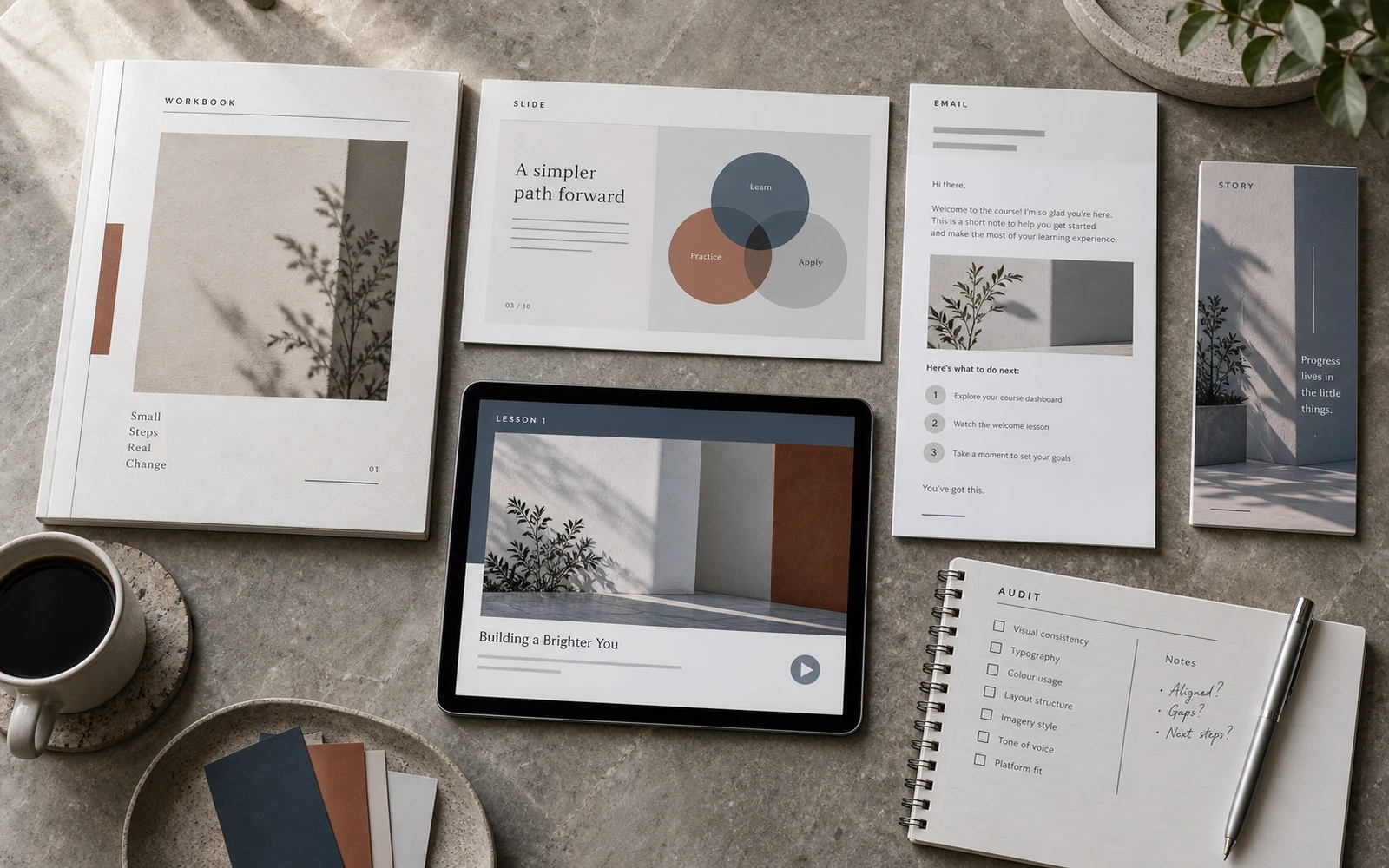
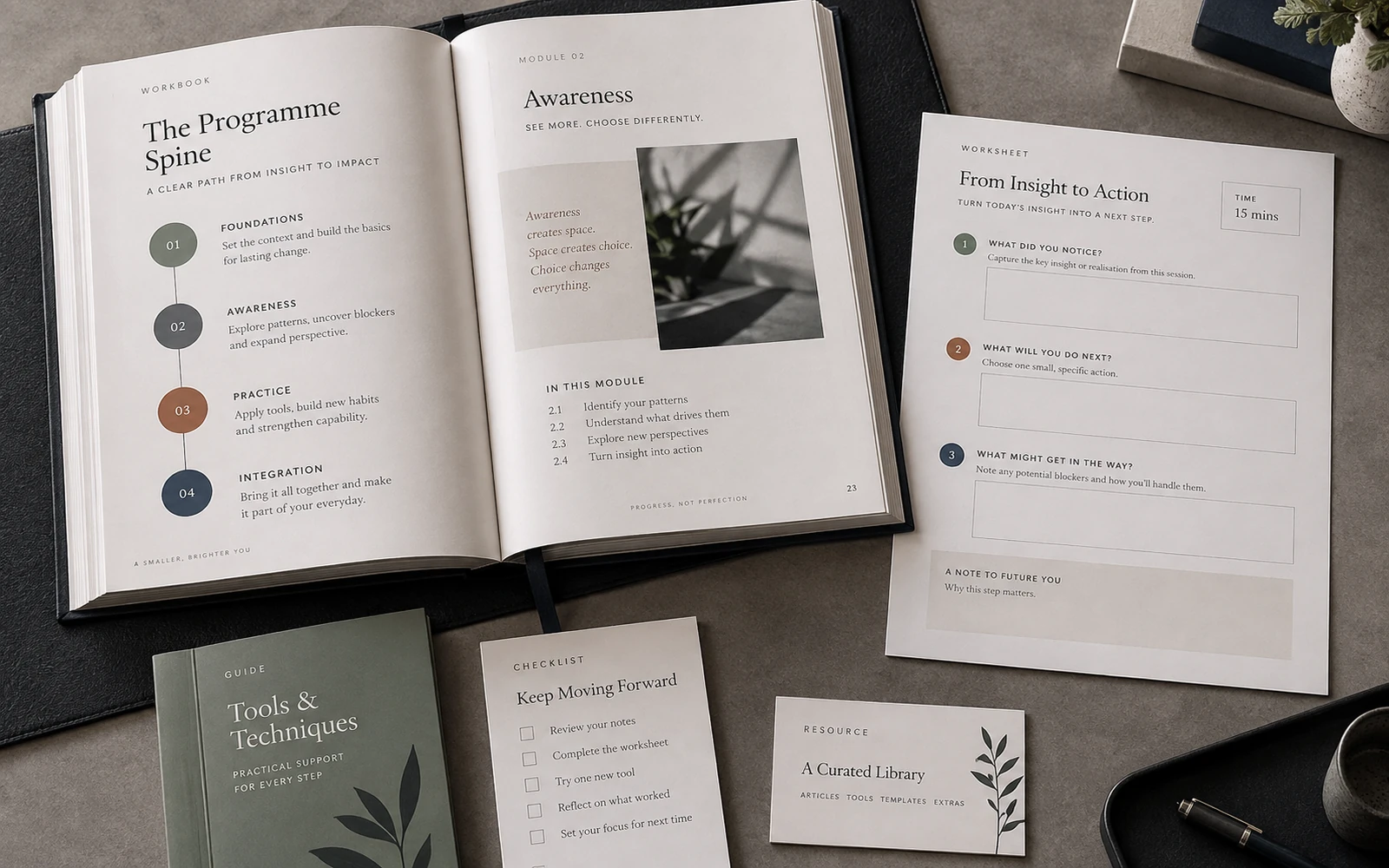
Different carriers stay one product if the model has the same name, and the map of “job → file” is clear: core, companion, resource library. Names by function. Then the team stops adding another chapter to the workbook “because that is how we already do it.”
Shared grid and type roles are not, here, a full system lecture — only the condition that a guide does not look like someone else’s handbook, and a sheet can be found from the lesson. Format is a decision about use. Every file should know why it exists.