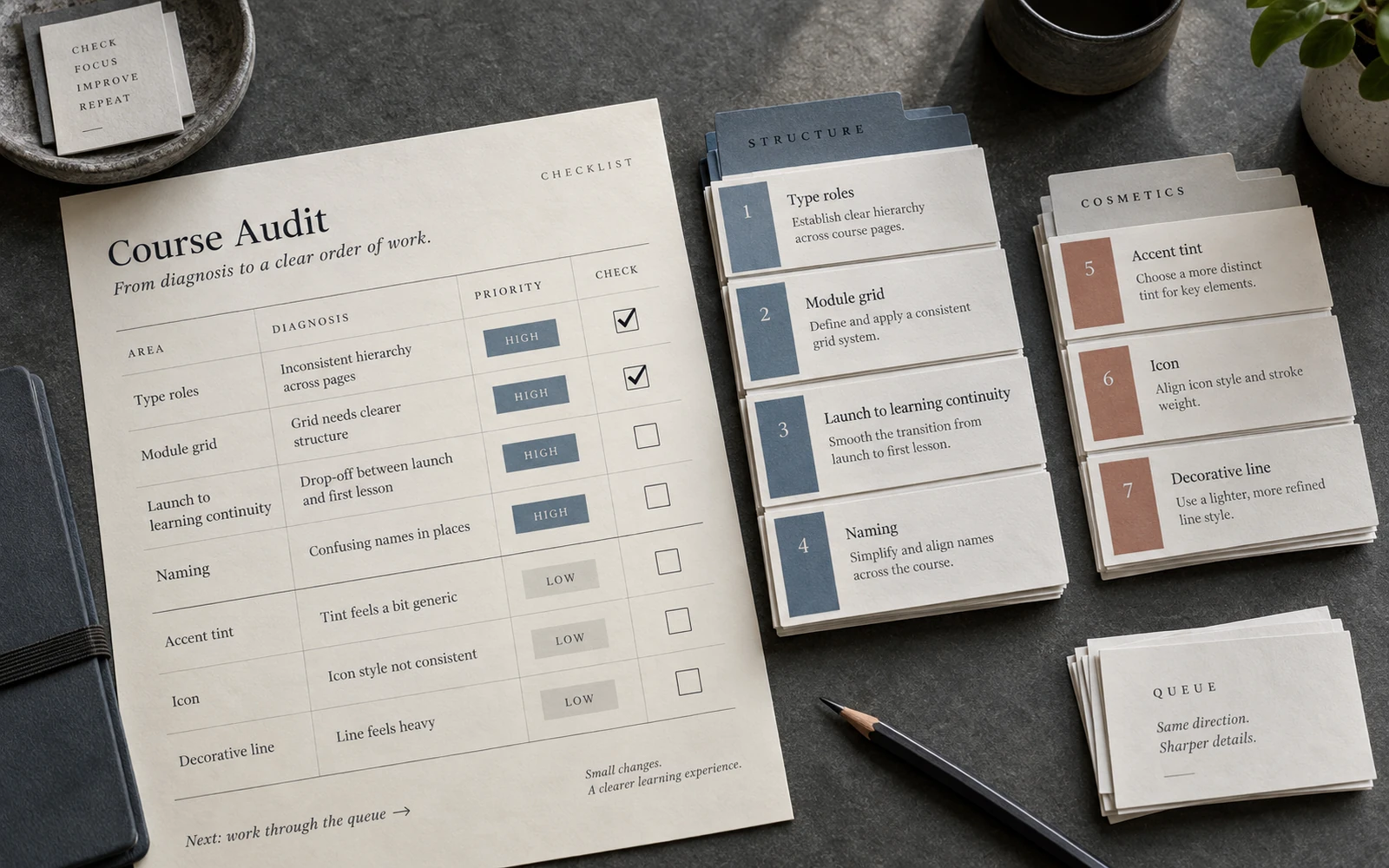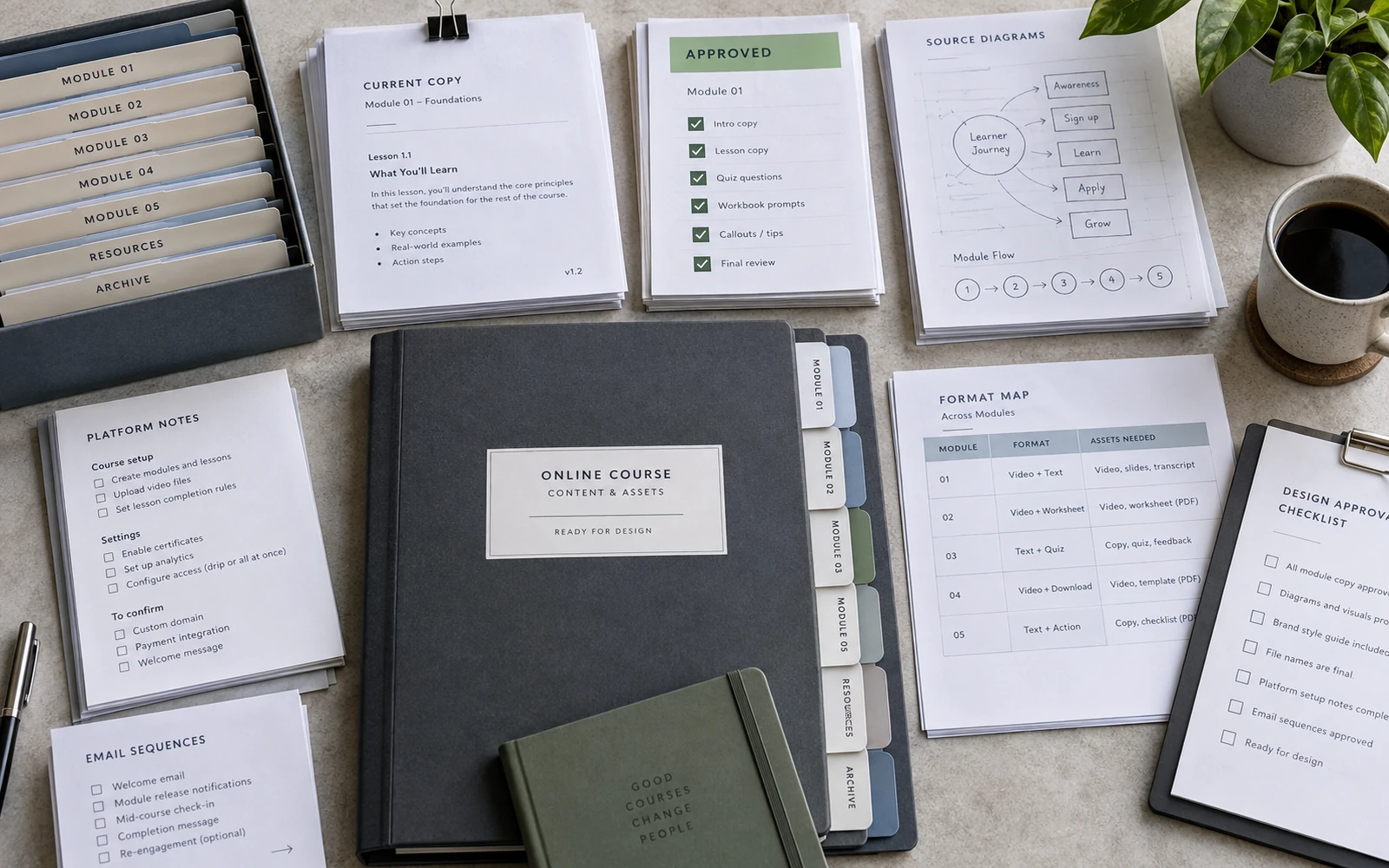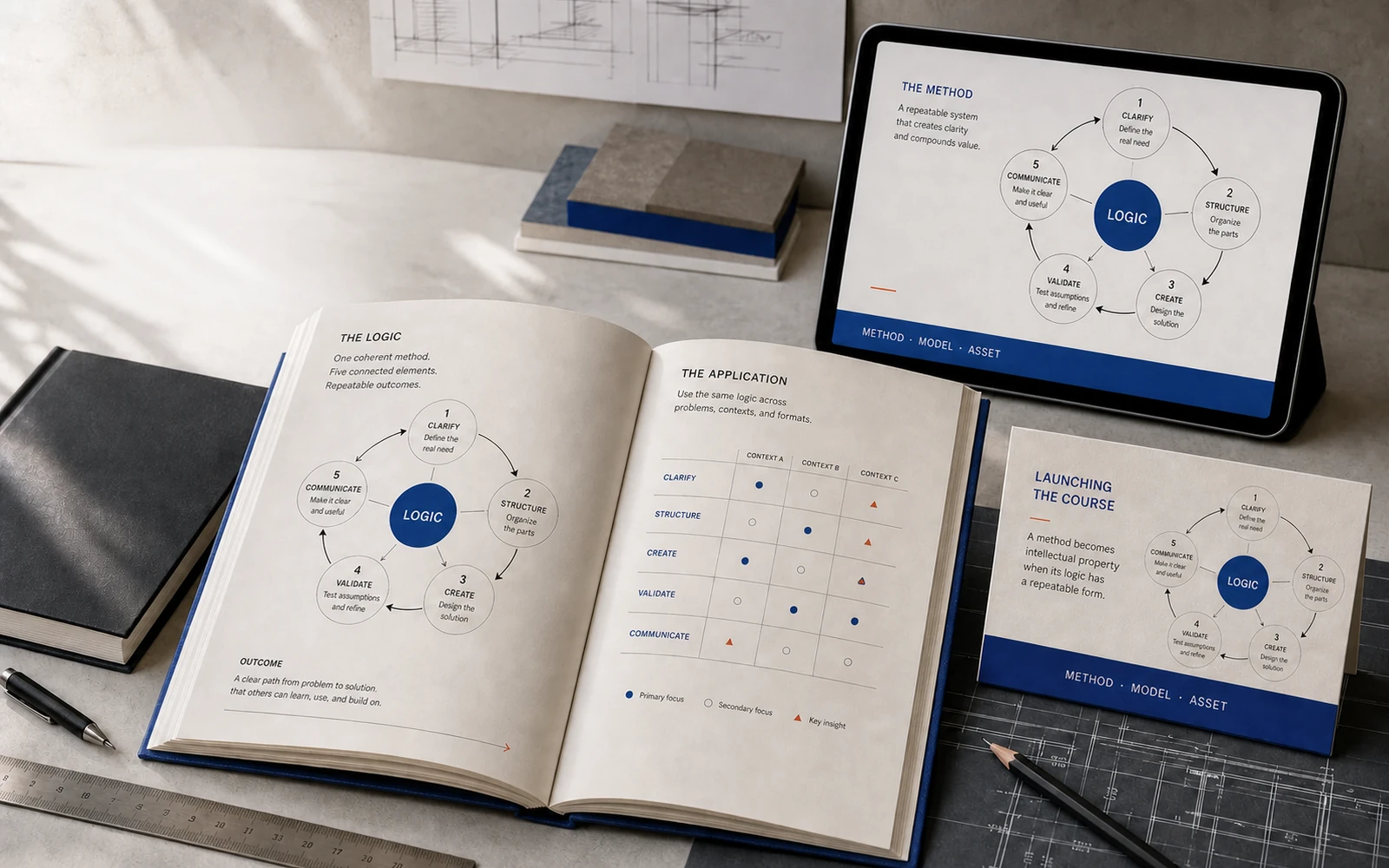
A fragmented course rarely looks broken. Each file on its own is “fine.” What is missing is not another cover, but a way to see the breaks before the next launch. Below are twelve signs. This is not a definition of a system, and not a learner-journey map. It is a quick diagnosis: the materials already exist; the product does not yet.
Separate cosmetics from structural breaks at the start. You do not have to repaint everything at once.
The files are branded. The decisions are not
01. Colour and logo repeat; the rules do not. A module heading in the workbook is not related to the slide title. The same model is drawn differently every time.
02. Without the wordmark, the files do not look like relatives. A palette remains, not a page behaviour.
03. Launch and learning sit at different “prices.” The ads look more expensive than the internal materials, or the course is more composed than the offer.
04. Dashboard, PDF and email hold different names for the same lesson. Someone looks up a topic and finds three wordings.
The first four signs catch a break between surfaces. They do not replace a look at hierarchy inside the page — that comes next.

The page does not hold its roles
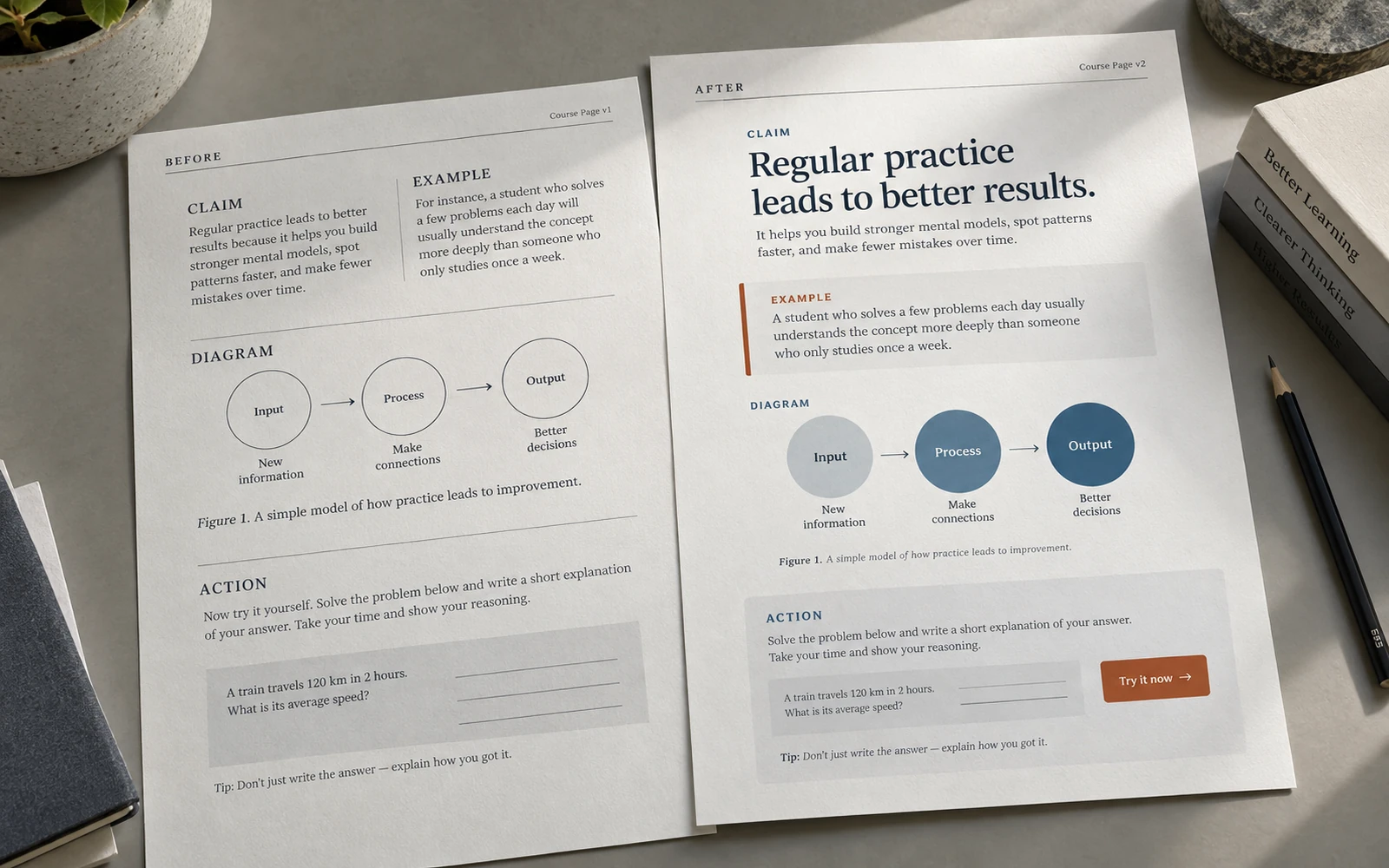
05. Claim, example, diagram caption and exercise instruction are set as equals.
06. The action only appears after you finish the paragraph. There is no stable place where “do this” begins.
07. Service noise shouts louder than the learning: panels, frames, extra accents around everything.
The audit here is concrete. Mark, on three pages and three slides, what is primary. If the answers differ, the roles are not fixed — even if the “style” looks similar.
Every new file invents a format
08. A new module arrives with a new grid.
09. Diagrams have no shared language: icons here, photographs there, arrows from another world.
10. There are many templates, but none of them survive dense copy, so another exception is built.
The check is not on the covers. It is on the last four files made “in a hurry.” Those show whether the system lives on a deadline.
Materials exist when the files exist. A system exists when a new file does not need a new taste.
The path and the ending look like other projects
11. From offer to first exercise there are several unjustified changes of character — not different jobs for the frames, but different products.
12. Certificate, archive and final email look as if they belong to another project than module one.
We are not laying out fifteen touchpoints here. We are only asking whether entrance and exit belong to the same course as the learning core.
After the signs: a queue, not a repaint
An audit is useful when it ends in a priority. High impact: unstable type roles, a new grid every module, names that have drifted, a split between launch and learning, a foreign ending. Cosmetics: the tint of a panel, a random icon, a small difference in a decorative line.
Do not start by repainting everything. Close two or three structural breaks a learner will meet in the next launch. Put the rest in a queue. Otherwise the twelve signs become an excuse to “update it all” again, and still not gather the rules.
Walk the list in an evening. Mark yes / no / not in this phase. The result is not a verdict. It is an order of work: what to treat now, and what can wait.